
Introduction
Reading is a foundational skill required for all academic success. A proficient reader allows one to access information, learn new things, and communicate effectively. SKIDOS believes that the ability to read well early in life leads to success in education, professional, and even personal life.
Each activity of SKIDOS IRIS is based on the Simple View of Reading, a theoretical model that explains reading as the product of two primary components: decoding and language comprehension. IRIS Activities like letter formation, tracing, blending to make new words, and learning to segment to form new words and sight words help a learner understand how to decode words. IRIS Activities on sight words and words learned in blending and segmenting would help a child to learn how to read and comprehend along with framing new phrases or short sentences too! This is how SKIDOS IRIS addresses the issue of low reading proficiency not just for the US market but globally too.
According to the original theory of the Simple View of Reading (SVR), an individual’s reading comprehension is the product of decoding skills and language comprehension. Massachusetts Department of Elementary and Secondary Education. (n.d.-c).
SKIDOS IRIS curriculum is based on the ‘Learn to Read’ module, aligned with the ‘Science of Reading’, and uses the SVR model for reading comprehension.
Literature Review
How would a little learner progress through reading from sounding out letters and words to finally reading fluently? The Simple View of Learning theory considers decoding and language comprehension to teach young minds how to learn to read proficiently.
Gough and Tunmer gave the formula for the Simple View of Reading (1986) –
Decoding x Language Comprehension = Reading Comprehension
Let us define each of these variables.
Decoding – a fast and accurate reading of familiar and unfamiliar words in sentences, phrases, and paragraphs.
Language Comprehension – the ability to understand the meanings of spoken words which are part of sentences, phrases, or paragraphs.
Reading Comprehension – the ability to understand the meanings of printed words.
The Simple View formula and research studies have shown that the reading comprehension score can be known if a learner’s decoding skills and language comprehension abilities are available.
According to Gough and Tunmer (1986), the Simple View of Reading explains and clarifies the role of decoding in reading. This is because most educators did not believe that strong decoding skills are necessary to achieve strong reading comprehension if language abilities are strong. Learners who struggle to read are often taught to guess an unfamiliar word based on the first letter or the picture. This is done because of their weak decoding skills. They are asked if they understand the word after reading the sentence. Learners are taught to sound out unfamiliar words by using each letter and to practice reading fluently until they achieve an adequate reading rate with accurate decoding. The Simple View of Reading | Reading Rockets. (n.d.).[MK¹]
Here are some important findings supporting the Simple View of Reading. These have major implications for educators providing reading instruction and assessment.
- Decoding deficit – Inability to read printed words accurately
- Language comprehension deficit – lack of knowledge or higher-order thinking skills such as reasoning or interpreting.
- Reading Difficulties: Lack of language comprehension (For example: a hyperlexic learner), unable to decode (For example, a dyslexic learner), or a lack of both
- Strong reading comprehension requires strong decoding skills and strong language comprehension abilities.
- With good decoding skills, reading comprehension equals language comprehension. So, if the decoding score is 1, reading comprehension score = language comprehension score = 0.5 (i.e. as per the formula, 0.5 = 1 x 0.5)
- With good language comprehension skills, reading comprehension equals decoding skills. So, if the language comprehension score is 1, and the decoding score is 0.7, the reading comprehension score = language comprehension score = 0.7 (i.e. as per the formula, 0.7 = 1 x 0.7)
Hence, any improvement in decoding score (or language comprehension score), when language comprehension (or decoding score) is 1, leads to an improvement in the reading comprehension score. However, if both the decoding and language comprehension scores are less than strong (< 1), reading comprehension will be lower than either. (i.e. 0.49 = 0.70 x 0.70). So, decoding and language comprehension scores would need to improve to have a high reading comprehension score for this kind of learner. For fluent and accurate reading, learners read words they have never seen before in print as well as words they have previously encountered using different strategies. For comprehension of texts, learners require enough language comprehension skills. The Simple View of Reading | Reading Rockets. (n.d.).[MK¹]
Infographic
For example, if a text says, “The little dog barked at the big cat,” each word must be read accurately with meaning by a proficient reader.

[MK²]Learning to read: “The Simple View of Reading.” (2022, December 2).
The following are some key points that educators can use to aim for maximum reading potential for their learners.
- For reading comprehension skills to be strong, a learn requires strong decoding and language comprehension skills.
- Effective intervention for struggling readers should target their specific weaknesses, whether in decoding, language comprehension, or both.
- Both are required to achieve reading comprehension.
- Even though decoding and language comprehension skills are required to achieve reading comprehension, both of these are separable for assessment as well as teaching.
- The Simple View formula as mentioned above is a mathematical formula. It has three variables. We can estimate any third variable if the values of the other two variables are available.
- The theory of the Simple View of Reading is supported by scientific research. The Simple View of Reading | Reading Rockets. (n.d.).[MK¹]
Research Studies
The Simple View of Reading, 1990
Hoover and Gough proved the Simple View formula through a study conducted with over 200 learners. Various assessments were used to evaluate learners’ progress in language, cognition, and reading skills. They were assessed each year from 1978-1985. Decoding was tested by asking learners to read nonsense words. And, learners answered questions and retold a story after listening to it so that their language comprehension could be tested. To test reading comprehension, learners were asked questions and they retold a story after reading it (instead of hearing it). The Simple View of Reading | Reading Rockets. (n.d.).[MK¹]
A Case for Simple View of Reading (2006)
A 2006 study by Catts, Adlof, and Wesmer supports the Simple View of Reading by examining three groups of Grade 8 learners: poor comprehenders (those with poor reading comprehension but normal word recognition), poor decoders (those with poor word recognition but normal reading comprehension), and typical readers (those with normal skills in both areas). According to the Simple View Formula, learners who struggle with reading comprehension but have strong decoding skills generally have weaker overall language skills.
The study found that learners with poor comprehension and normal word recognition had consistently lower language abilities compared to the other two groups, showing deficits in language comprehension despite normal phonological processing abilities. In contrast, learners with poor decoding skills and strong reading comprehension displayed the opposite pattern: their oral language comprehension scores were higher than their phonological processing scores. The study also reinforces the connection between poor decoding skills and a phonological deficit. The Simple View of Reading | Reading Rockets. (n.d.).[MK¹]
Compare and Contrast
Several scientists have tried to disprove the Simple View of Reading. Following are some of them.
Seidenberg, A. M. (2023b, May 26). The “science of reading” approach in education is being carried forward by influencers whose background in cognitive science is limited. Reading with young children is great but it’s not sufficient to ensure they’ll learn to read, which almost always requires some amount of instruction. The Simple View of Reading is also great but not sufficient to decide important issues about how to teach reading. Actually, the SVR is more like a cake recipe that specifies “wet ingredients” and “dry ingredients”, because the terms “word recognition” and “language comprehension” can signify many things. What kinds of information and mental computations are involved in each? How are they learned? How do they fit together? Why do learners differ in how they progress? The SVR doesn’t provide much guidance because these questions weren’t the focus of the work.
Plthomasedd. (2024c, September 11). Commitments to SVR and phonics first are a distortion of goals in reading instruction, replacing the authentic goal (critical comprehension) with measuring if students have acquired the entire set of phonics rules. Phonics instruction and emphasizing decoding must remain some of the means and not the ends of instruction; however, the SoR movement too often has created that fatal flaw.
However, if SVR had any flaws, none of the above have provided any solutions to overcome the flaws. As per Linda Farell, reading expert and founding partner at Readsters in Alexandria (Virginia), SVR cannot be disproved.
(Linda Farell) I give lots of workshops all over the country and I give them on all different aspects of struggling reading. And I start every single workshop with the same introduction and it’s called the Simple View of Reading. It’s research that is the most important research in my opinion, that’s ever been done on reading because it clarifies very clearly what good readers do well and what those who don’t read so well struggle with. And the simple view of reading is research that was first done in 1990. It was proposed in 1986, and it’s been replicated hundreds of times since then. People have tried to disprove it and they’ve tried to prove it. They can only prove it. They cannot disprove the simple view of reading. And what it says simply is that reading is made of two components, decoding and language comprehension. In order to be strong at reading comprehension, you got to be strong at decoding and you got to have background knowledge and understand the words that you’re reading. The Simple View of Reading | Reading Rockets. (n.d.).[MK¹]
Progress made over the years
Following are some points explaining the progress made by the Simple View of Reading:
- Earlier, learning to read was typically considered to mean decoding, an understanding of how written words are converted into spoken words. To read accurately and quickly, automatic decoding skills are a pre-requisite. Learners need to understand how to comprehend written texts and the foundations of this understanding can be established long before learners formally start learning how to decode. Anderson, P. (2015, October 21). However, as discussed above, according to Gough and Tunmer (1986), the Simple View of Reading explains and provides clarity around the role of decoding in reading. This is because most educators did not believe that strong decoding skills are necessary to achieve strong reading comprehension if language abilities are strong. The Simple View of Reading | Reading Rockets. (n.d.).[MK¹] So, the SVR model shifted the focus from phonics and decoding to the importance of comprehension. Decoding alone is not enough for success in reading. Wang, T. O. (n.d.).
- Early reading interventions largely concentrated on building word-level skills to enhance fluency. Recent research, however, emphasizes the importance of teaching comprehension strategies, with word-level instruction added as needed for students who have yet to master decoding. Scammacca, N. K., Roberts, G. J., Cho, E., Williams, K. J., Roberts, G., Vaughn, S. R., & Carroll, M. (2016). A century of progress. Review of Educational Research, 86(3), 756–800. However, as stated above, according to the Simple View of Reading, reading has two components: word recognition/decoding and language comprehension. This formula helps educators with assessing reading weaknesses in a learner and providing appropriate instruction. Farrell, L., Davidson, M., Hunter, M., Osenga, T., & Readsters, LLC. (2010). The simple view of reading: research of importance to all educators. Readsters, 1–9.
- The process of reading comprehension and its implications for literacy acquisition in deaf children is justified well by the Simple View of Learning. It becomes easier for educators to design effective interventions in decoding and language comprehension to support the literacy development of deaf learners. Karen, & Karen. (2024, May 28). Supporting Success For Children With Hearing Loss | The Simple View of Reading and its Implications for Literacy Acquisition in Deaf Children. Supporting Success for Children With Hearing Loss | Helping YOU Help Kids Who Are Deaf or Hard of Hearing Succeed.
- SVR has provided reading programs for neurodivergent kids as well. There are programs to meet these needs of learners with disabilities like Dyslexia, Hyperlexia, etc. Admin. (2021, August 16). The Simple Viappew of Reading (SVR)-Part 1 – Orton Gillingham Online Academy. Orton Gillingham Online Academy, Admin. (2018, May 31). The Simple View of Reading (SVR)-Part 2 – Orton Gillingham Online Academy. Orton Gillingham Online Academy, Admin. (2018b, June 4). The Simple View of Reading (SVR)-Part 3 – Orton Gillingham Online Academy. Orton Gillingham Online Academy.
Research Methodology
The research methodology is based on the following data points or research which explain why learning to read is an important requirement. Grade-level reading proficiency is low globally. Vazquez-Lopez, V., & Huerta-Manzanilla, E. L. (2021).
SKIDOS’ major user market is the US where grade-level reading proficiency is low as per the NAEP report. NAEP Reading: National Achievement-Level Results. (n.d.), NAEP Reading: National Achievement-Level Results. (n.d.-b)
- Low Grade-level Proficiency in Reading Globally: According to research, it has been found that reading proficiency is quite low globally. To become proficient readers, it is necessary to start by sounding out letters and words and then decode and comprehend them for fluency and proficiency. This is considered under the ‘Learn to Read’ module of the Science of Reading. A learner shifts to the ‘Read to Learn’ module once the ‘Learn to Read’ module, a prerequisite for reading to learn, has been completed. SKIDOS IRIS takes care of the ‘Learn to Read’ module. Vazquez-Lopez, V., & Huerta-Manzanilla, E. L. (2021).
- Low Grade-level Proficiency in Reading in the US: The major user base of SKIDOS is the US market. According to the US National Center for Education Statistics (NCES), 34% of students are below the basic reading level in the 4th grade and another 31% are below the proficient reading level. The Condition of Education 2020. (n.d.). NAEP Reading: National Achievement-Level Results. (n.d.), NAEP Reading: National Achievement-Level Results. (n.d.-b).
Product Prototype
The methodology includes prototype creation & user testing. In the course of product development in 2023, prototype testing of IRIS was undertaken for a “Go”/ “No Go” and completed. This comprised planning for methodology and approach to follow.
About the prototype – The prototype was developed under the guidance of Ms Jaya Sharma, a certified teacher in Ontario, an educationist, and an ed-tech and publishing professional. It comprised two domains – Decoding and reading comprehension; to be aligned with the Simple View of Reading
Prototype Features – It included a video (a letter story) followed by comprehension questions from the story
User characteristics
- 5 families were chosen with kids over 3.5 years of age.
- Participants (both boys and girls) belonged to different diversities,
- The kids attended public schools,
- High school graduate Parents
- Mid-income to higher SES families
This was followed by the conduction of in-depth qualitative interviews for prototype testing with five Parent-child dyads and assessing actionable insights from the findings. These insights were then incorporated into the main product for final development.
Interview structure and process
The IRIS user interviews followed a semi-structured approach, combining closed and open-ended questions. During the sessions, learning content—including videos, rhymes, and interactive animations—was evaluated to gather in-depth feedback. Interviews were meticulously transcribed after multiple video reviews, enabling the development of themes through analysis. Time-stamped observations were organized and presented according to the Thematic Analysis and LEARS Scorecard frameworks. Insights from parents and children were documented, capturing their perspectives and the values generated, which contributed to the analysis and interpretation.
Prototype Evaluation (LEARS Scorecard)
To facilitate thorough assessment and evaluation of a product or offering by various stakeholders, the LEARS framework was developed. In Scottish, “lears” means a lesson, and in this context, it serves as a tool to streamline appraisal and decision-making (e.g., “Go” / “No Go”). The LEARS framework comprises five dimensions: Learning Outcome Fidelity (L), Effectiveness (E), Aspects of User and Technological Experience (Autx), Referrals and Sharing (R), and Satisfaction (S), each with specific sub-dimensions.
The evaluation of IRIS, conducted through qualitative interviews, utilized the LEARS Scorecard. This approach yielded positive results in areas like credibility, relatability, ease of use, engagement, visual appeal, likability, Net Promoter Score (NPS), and saturation index—essential benchmarks for a successful, competitive product launch.
Final Product Testing
To align with the Simple View of Reading (SVR) model, SKIDOS IRIS incorporates a balanced mix of decoding and language comprehension activities. Decoding skills are strengthened through interactive tasks like blending, segmenting, and sight words, while language comprehension is supported by letter stories, rhymes, formation, tracing activities, and assessments. For reading comprehension, engaging story animations provide interactive experiences for learners.
Following user testing, SKIDOS IRIS underwent rigorous internal testing by the SKIDOS technical teams, leading to its successful launch in March 2024.
Discussion
SKIDOS IRIS is designed to build reading proficiency across grade levels, addressing the prevalent challenge of low literacy rates through a research-backed curriculum. Rooted in the Simple View of Reading—a foundational model within the Science of Reading—the IRIS program focuses on developing both decoding and language comprehension skills essential for achieving full reading comprehension. Despite attempts by various scientists to disprove it, the Simple View of Reading remains a robust and validated theory, underscoring the effectiveness of IRIS in fostering essential literacy skills.
Recommendation
The methodology and pedagogy in SKIDOS IRIS are designed for both classroom teachers and homeschoolers, offering a structured, effective approach to reading instruction. Rooted in the Simple View of Reading theory, IRIS supports skill development across traditional and homeschooling settings. With its “learn to read” module, IRIS enables teachers to provide highly structured instruction, helping learners build foundational skills. Soon, SKIDOS IRIS will introduce a “read to learn” module, further supporting literacy progression. Additionally, IRIS is beneficial for children with dyslexia and dysgraphia, making its learning content accessible and inclusive.
Conclusion
SKIDOS IRIS offers a unique and impactful gameplay experience designed to build essential reading skills like decoding and language comprehension. Aligned with the Science of Reading, it delivers an authentic, meaningful approach to literacy. The curriculum integrates engaging stories, rhymes, letter formation, tracing, blending and segmenting exercises, sight words, assessments, and sentence reading, making learning fun and effective. Regular engagement with SKIDOS IRIS can significantly boost reading skills, enhance phonemic awareness, and improve reading comprehension. Students benefit from stronger communication skills, academic and personal growth, cognitive well-being, and an enriched vocabulary and knowledge base.
References
Unknown. (2021). The science of reading. https://www.in.gov/doe/files/3-science-reading.pdf
Massachusetts Department of Elementary and Secondary Education. (n.d.). What is the simple view of reading? – Evidence based early literacy. https://www.doe.mass.edu/massliteracy/skilled-reading/simple-view.html
[MK¹]The Simple View of Reading | Reading Rockets. (n.d.). Reading Rockets.https://www.readingrockets.org/topics/about-reading/articles/simple-view-reading
[MK²]Learning to read: “The Simple View of Reading.” (2022, December 2). National Center on Improving Literacy. https://improvingliteracy.org/brief/learning-read-simple-view-reading/
Seidenberg, A. M. (2023c, May 26). Decoding “The Simple View of Reading.” Reading Matters.https://seidenbergreading.net/2023/05/26/decoding-the-simple-view-of-reading/
Plthomasedd. (2024c, September 11). The fatal flaws of the SOR movement: SVR and Phonics first. Dr. p.l. (Paul) Thomas.https://radicalscholarship.com/2022/08/31/the-fatal-flaws-of-the-sor-movement-svr-and-phonics-first/
Scammacca, N. K., Roberts, G. J., Cho, E., Williams, K. J., Roberts, G., Vaughn, S. R., & Carroll, M. (2016). A century of progress. Review of Educational Research, 86(3), 756–800. https://doi.org/10.3102/0034654316652942
Farrell, L., Davidson, M., Hunter, M., Osenga, T., & Readsters, LLC. (2010). The simple view of reading: research of importance to all educators. Readsters, 1–9. https://www.readsters.com/wp-content/uploads/SimpleView.pdf
Karen, & Karen. (2024, May 28). Supporting Success For Children With Hearing Loss | The Simple View of Reading and its Implications for Literacy Acquisition in Deaf Children. Supporting Success for Children With Hearing Loss | Helping YOU Help Kids Who Are Deaf or Hard of Hearing Succeed. https://successforkidswithhearingloss.com/the-simple-view-of-reading-and-its-implications-for-literacy-acquisition-in-deaf-children/
Admin. (2021b, August 16). The Simple View of Reading (SVR)-Part 1 – Orton Gillingham Online Academy. Orton Gillingham Online Academy. https://ortongillinghamonlinetutor.com/the-simple-view-of-reading-svr-part-1/
Admin. (2018c, May 31). The Simple View of Reading (SVR)-Part 2 – Orton Gillingham Online Academy. Orton Gillingham Online Academy. https://ortongillinghamonlinetutor.com/the-simple-view-of-reading-svr-part-2/
Admin. (2018e, June 4). The Simple View of Reading (SVR)-Part 3 – Orton Gillingham Online Academy. Orton Gillingham Online Academy. https://ortongillinghamonlinetutor.com/the-simple-view-of-reading-svr-part-3/
Vazquez-Lopez, V., & Huerta-Manzanilla, E. L. (2021). Factors Related with Underperformance in Reading Proficiency, the Case of the Programme for International Student Assessment 2018. European Journal of Investigation in Health Psychology and Education, 11(3), 813–828. https://doi.org/10.3390/ejihpe11030059
NAEP Reading: National Achievement-Level Results (n.d.).https://www.nationsreportcard.gov/reading/nation/achievement/?grade=4
NAEP Reading: National Achievement-Level Results (n.d.-b).https://www.nationsreportcard.gov/reading/nation/achievement/?grade=8, https://youtu.be/BhpHr3SC7hk
Anderson, P. (2015, October 21). Teaching reading in the early years. Australian Council for Educational Research – ACER.https://www.acer.org/in/discover/article/teaching-reading-in-the-early-years
Wang, T. O. (n.d.). Decoding in Reading Comprehension | ETS Stories.https://www.ets.org/news/stories/the-critical-role-decoding-plays-in-reading-comprehension.html
Appendix
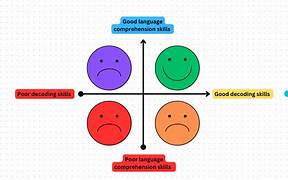
The Simple View of Reading theory is explained nicely by Tess Prendergast. Look at the below image.
 Prendergast, T. (2023, July 16). Understanding the simple view of reading. ALSC Blog. https://www.alsc.ala.org/blog/2023/07/understanding-the-simple-view-of-reading/
The above image is adapted from Literacy as a Complex Activity: Deconstructing the Simple View of Reading
Prendergast believes that reading development takes place with the Simple View of Reading. She uses vertical and horizontal axes with emoticons to explain how both decoding and language comprehension skills are essential for reading comprehension.
In the image, there are two axes – one for decoding and another for language comprehension. The quadrant with the happy green emoticon is only one and hence, explains how both skills are important for learners to become good readers.
The purple sad face indicates a learner who has good language comprehension but poor decoding skills. For example, this learner would know what a ‘book’ is but he won’t be able to decode the word ‘book’ or read the word ‘book’.
The orange sad face indicates a learner is a good decoder but poor at language comprehension. For example, this learner would be able to decode or read a word say ‘log’ but he would not know its meaning unless someone showed it to explain it.
The red sad face indicates a learner who needs the most help as this learner does not know how to decode a word and sound out the letters or has any understanding of what it means. These learners need both skills to achieve reading comprehension.
Acknowledgments
I extend my heartfelt gratitude to SKIDOS founder Aditya Prakash, Product Manager Tehleel Bashir, and the entire product, design, and technical teams for their invaluable support and guidance throughout the creation of IRIS. A special thanks to Jaya Sharma, a certified teacher in Ontario and an esteemed educationist with a background in ed-tech and publishing, whose insights were instrumental in shaping the design and development of SKIDOS IRIS, “I Read, I Succeed.” We are excited about the journey ahead and hopeful for the success of SKIDOS’ “Learn to Read” program, IRIS (I Read, I Succeed)!